By Tredu.com
• Tredu
Why FOMO Is a Liquidity Signal
2/18/2026
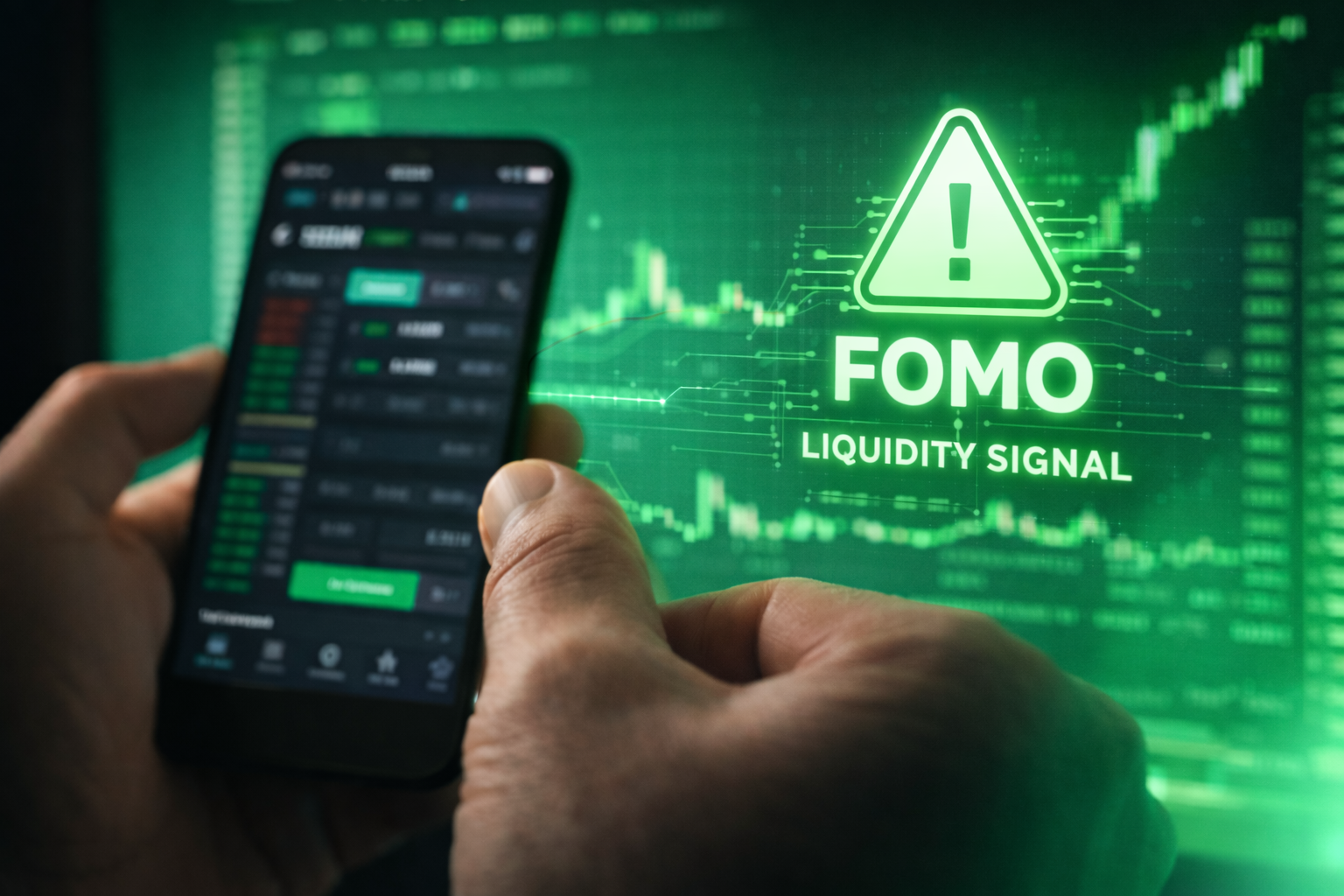
Few forces undermine trading performance as quietly and as consistently, as the fear of missing out.
FOMO (Fear of Missing Out) begins with a simple but powerful assumption: that a profitable opportunity is slipping away and that failing to act immediately will result in permanent loss. Embedded in this belief is the idea that meaningful opportunities are rare. If this one is missed, another may not come soon or at all.
Under that pressure, discipline weakens. Carefully tested strategies are abandoned at the point of execution. Entries are rushed. Risk parameters expand. Positions are opened not because the setup meets predefined criteria, but because urgency overrides process. What follows is often predictable: trades taken without edge, poorly timed participation and exposure that exceeds acceptable risk.
The emotional aftermath can be just as damaging as the financial one. Traders frequently experience regret, anxiety or self-doubt after impulsive decisions. Over time, repeated episodes erode confidence in both strategy and self. Losses fuel frustration and frustration drives further impulsivity. A feedback loop forms, compounding both emotional strain and capital drawdown.
FOMO often disguises itself as intuition; the need to “be in the market” or the feeling that momentum must be captured immediately. But what feels like instinct is often pressure. And what appears to be opportunity may simply be acceleration.
However, reducing FOMO to psychology alone overlooks an important structural component of how markets function. While FOMO is typically framed as a psychological flaw, sharp price movements do not originate from emotion. They originate from shifts in liquidity. When participation becomes urgent, it is often because liquidity is being aggressively consumed.
To understand FOMO properly, we must move beyond psychology and examine market structure. What traders interpret as fear of missing out may, in fact, be a visible signal of underlying liquidity imbalance.
And that distinction changes everything.
What FOMO Actually Signals
FOMO typically emerges during strong directional moves when price accelerates faster than the average participant expected. This acceleration indicates that momentum is dominating short-term decision-making. When participants rush in simultaneously, they reduce available liquidity on the opposite side of the order book. This is why sharp price expansions often occur during periods of intense emotional participation. Additionally, late entrants are willing to accept worse prices to participate leading to a market sentiment shift from uncertainty to urgency. Our analysts describe FOMO as less about psychology and more about timing.
Liquidity and Market Structure
Markets function through liquidity; the availability of buyers and sellers at different price levels. When FOMO is present, liquidity conditions begin to shift as market orders increase relative to limit orders, spreads widen and slippage becomes more frequent. These changes signal rising stress within market structure rather than random volatility. A balanced market typically maintains layered liquidity on both sides of the order book, allowing price to move in a stable and orderly manner. During FOMO phases, however, that balance weakens because participants prioritize execution over price efficiency. As urgency replaces patience, price can move sharply in either direction depending on order-flow pressure. Our analysts note that these moves are often unstable because they are driven more by participation speed than by sustained demand.
Why Institutions Anticipate FOMO
Professional traders and institutions monitor sentiment indicators, volume patterns and volatility expansion to identify early signs of FOMO behaviour. These signals matter because retail participation often increases late in trends, emotional buying or selling tends to cluster, and crowded positioning can produce predictable reactions. Rather than chasing price, institutions typically watch for moments when participation becomes excessive and liquidity begins to thin. At that stage, they may scale out of positions, hedge exposure or adjust risk parameters to manage changing conditions. Our analysts emphasize that while many traders experience FOMO as a reaction, experienced participants treat it as a signal and prepare for it in advance, positioning strategically instead of responding impulsively.
When FOMO Becomes Fragile
Not all FOMO-driven moves collapse, but they tend to become fragile when volume spikes sharply without structural support, price deviates significantly from recent averages, and volatility expands faster than liquidity. These conditions signal instability rather than
immediate reversal. Markets driven primarily by urgency depend on a continuous inflow of new participants to maintain momentum. If that participation slows, price can stall or retrace quickly because underlying support is limited. Our analysts stress that learning to recognize this distinction is essential, as the objective is not to avoid strong trends but to evaluate whether they are sustained by durable participation or propelled mainly by emotional urgency.
Bottom Line
FOMO is often treated as a psychological weakness, but in practice it frequently reflects changing liquidity conditions within the market. When price accelerates rapidly, participation increases, order flow becomes aggressive and available liquidity thins, urgency naturally follows. What traders experience emotionally is often the surface expression of a structural imbalance.
Understanding this distinction shifts the focus from self-criticism to market analysis. Instead of reacting to the pressure to participate, traders can assess whether liquidity is expanding or deteriorating, whether volume confirms sustainability and whether momentum is supported by depth or driven primarily by speed.
FOMO does not cause market moves. It accompanies them. Recognizing it as a liquidity signal rather than merely an emotional impulse allows traders to manage risk more objectively and position themselves with structure rather than urgency.
Other Recent Posts
Understanding Commodities: How Oil and Precious Metals Influence Global Markets
By Tredu Research Team · 3/10/2026
Why Global Events Are Back at the Centre of Trading: Macro Matters
By Tredu Research Team · 3/2/2026

From Volatility to Collateral: Bitcoin’s Next Financial Role
By Tredu Research Team · 2/24/2026