SoftBank Dumps Nvidia Stake to Plow Billions Into OpenAI

By Tredu.com • 11/13/2025
Tredu
What happened, in one line
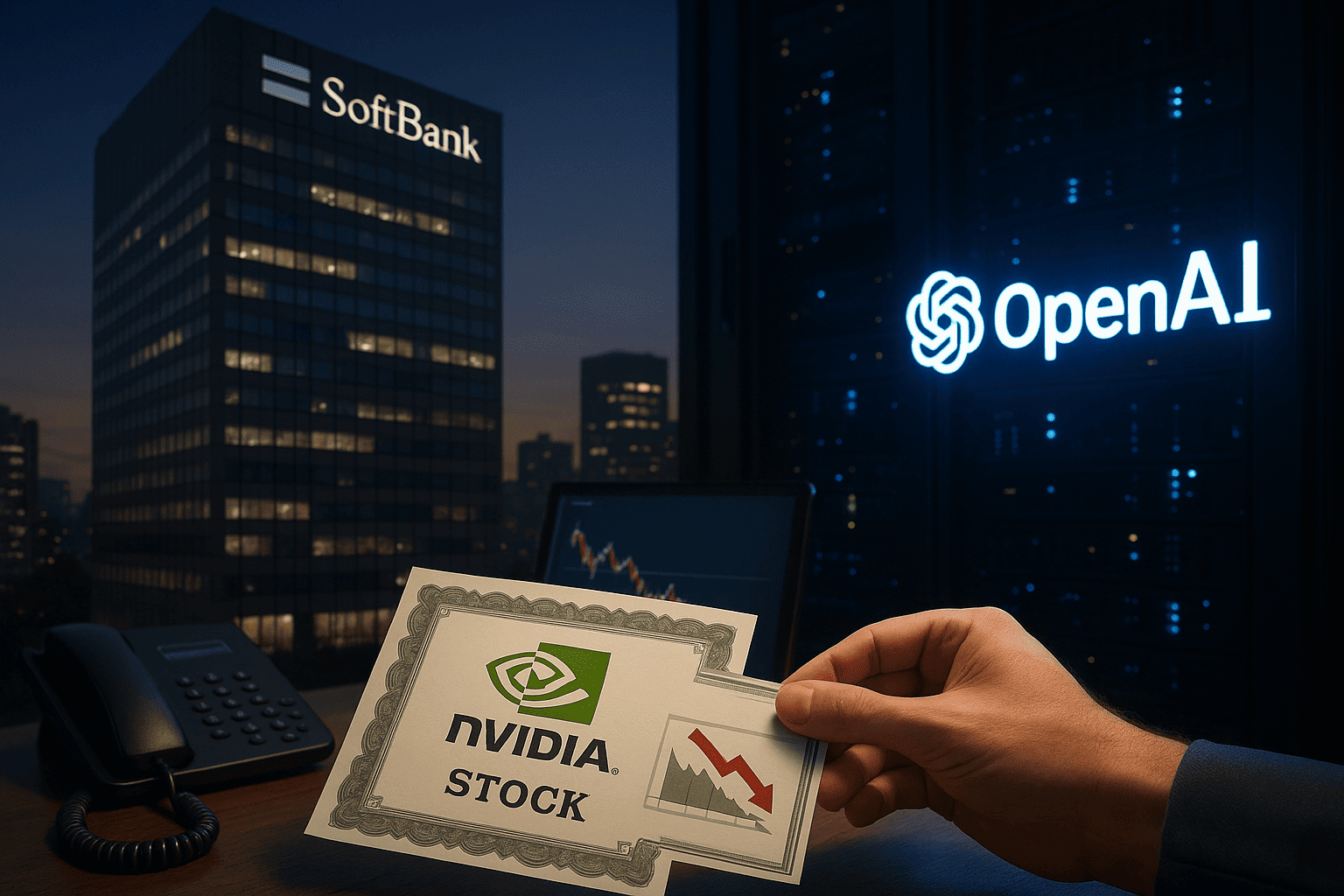
SoftBank sold its entire Nvidia position for roughly $5.8 billion, a complete October exit that raised cash for an aggressive OpenAI centric investment agenda, according to filings and multiple reports.
The transaction, by the numbers
SoftBank disposed of about 32 million Nvidia shares in October for proceeds of roughly $5.8–$5.83 billion, ending public exposure to the AI chip leader after a historic run. The sale is part of a broader program that also included monetizing a $9.2 billion block of T-Mobile US shares between June and September, lifting available liquidity for new AI commitments.
Why now: funding the OpenAI push
Chairman Masayoshi Son is channeling capital toward OpenAI and related projects, with reporting pointing to commitments and ambitions in the tens of billions of dollars. The Financial Times and AP framed the Nvidia sale as a funding lever for those investments, including cloud software, data centers and potential tie-ups that position SoftBank as an AI platform investor rather than a listed semiconductor holder.
Market reaction and the Nvidia read-through
Headlines around the disposal clipped Nvidia in early trading, though the effect was small relative to its multi-trillion valuation. Sell-side commentary emphasized that the exit is modest versus Nvidia’s float, yet it is symbolically notable given SoftBank’s long AI narrative. The stock wobbled around the news, then refocused on earnings and capacity ramps that remain the primary driver of sentiment.
Strategy shift: from chip ownership to AI equity and infra
The pivot reframes SoftBank’s exposure. Instead of holding a supplier’s equity, the group is funding the demand side of the AI loop, namely model development and cloud capacity that, in time, still buys Nvidia’s accelerators. Reuters’ analysis described this as a circular capital flow, profits realized on Nvidia recycled into OpenAI, with those projects expected to consume more Nvidia hardware.
Balance sheet, liquidity and risk
Analysts see the cash build as both optionality and a test. The FT noted SoftBank has stacked large capital commitments relative to identified funding, which raises questions about timing and pace of deployments. Yahoo Finance tracked a negative share-price reaction in Tokyo after the disclosure, a reminder that de-risking one line item can raise scrutiny on the next. The group counters that realized gains and portfolio rotation support a multi-year AI plan.
The Arm angle, still central
SoftBank retains significant exposure to Arm, a beneficiary of AI at the edge and in data centers through CPU designs, interconnects and ecosystem licensing. For investors who want SoftBank’s semiconductor upside without Nvidia single-name risk, Arm remains the core lever. Public records show SoftBank continuing to own a large Arm stake post IPO, which anchors the group’s chip narrative even after the Nvidia sale.
How this fits the operating playbook
SoftBank has a history of cycling assets to fund new themes. Exiting listed stakes during rallies, then redeploying into earlier-stage or platform assets, has been part of the Vision Fund era. The Nvidia exit aligns with that pattern, with proceeds directed to OpenAI relationships, data-center partners and software providers. Management’s message, reported across outlets, is that return opportunities now skew toward owning the AI application and infrastructure stack, not only the chip equity most in focus.
What to watch next
Three markers will gauge whether SoftBank’s reweighting pays off. First, transparency on the size and structure of OpenAI linked commitments, including cash outlay timelines. Second, evidence that data-center and cloud partnerships convert into contracted economics rather than aspirational MoUs. Third, the trajectory of Arm, which serves as a public mark for part of the semiconductor thesis. A clear path on these items would validate the rotation from Nvidia ownership to platform exposure.
Investor framing
For equity holders, the move trades a concentrated, liquid winner for a basket of higher-variance bets. The upside case argues that platform equity and infra stakes compound faster as AI adoption widens; the downside case is that private market valuations can be cyclical and less transparent. Portfolio construction will likely balance these realities, pairing AI venture exposure with listed cash generators to smooth drawdowns. Coverage also highlighted that the Nvidia sale does not preclude future cooperation; OpenAI projects and partner clouds that SoftBank backs will still procure Nvidia compute.
The headline in context
The core idea is simple and bears repeating for clarity: SoftBank dumps Nvidia stake to plow billions into OpenAI. The mechanics, a complete October sale worth roughly $5.8 billion; the rationale, to bankroll a larger strategic bet on AI models, software and infrastructure that SoftBank believes will define the next leg of growth.
Bottom line
SoftBank sold Nvidia to fund a deeper OpenAI centric strategy, swapping a public chip position for platform and infrastructure exposure. If those AI investments crystallize into contracted cash flows and Arm continues to scale, the rotation can work; if capital needs outrun funding or valuations compress, the trade will be tested.