By Tredu Research Team
• Tredu
Understanding Commodities: How Oil and Precious Metals Influence Global Markets
3/10/2026
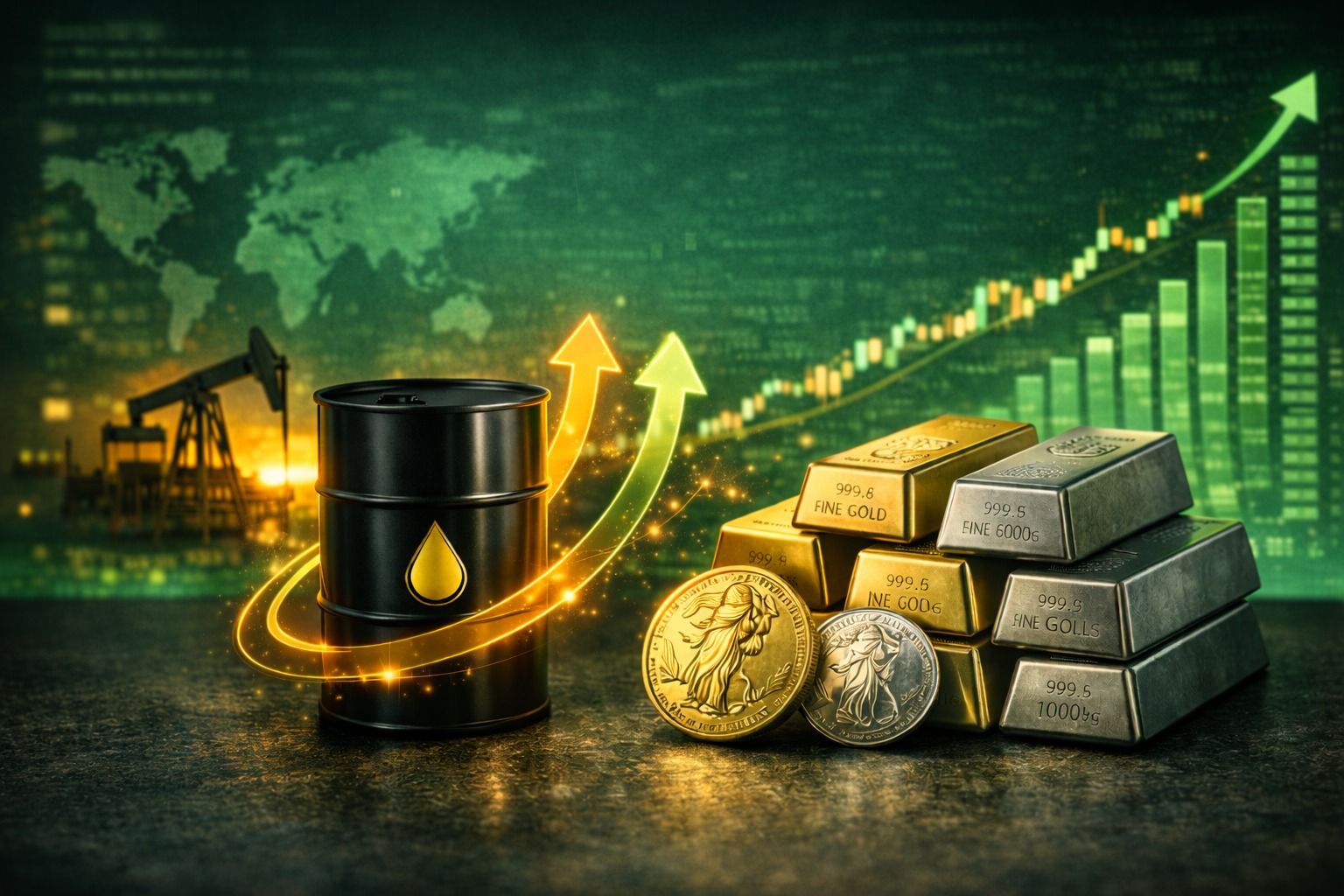
Global markets are often discussed through the lens of stocks, currencies or interest rates. Yet beneath these financial instruments lies a more fundamental layer of the global economy: commodities. From the crude oil that powers transportation and manufacturing to the precious metals that store value during financial uncertainty; commodities play a critical role in shaping economic cycles, inflation trends and geopolitical strategy.
Because commodities are essential inputs for production and trade, their prices often respond quickly to shifts in supply chains, political tensions and changes in monetary policy. When oil rises, the cost of global commerce increases. When gold rallies, it often signals rising uncertainty within the financial system. Understanding these signals can provide valuable insight into how broader markets, from equities to currencies, may behave.
This article explores how two of the most influential commodity groups such as energy and precious metals, shape global markets. By examining the role of crude oil, the safe-haven function of gold and the emerging connection between traditional commodities and digital assets like Bitcoin, we can better understand how macroeconomic forces ripple across modern financial markets.
What are Commodities?
Commodities are raw materials that serve as the building blocks of the global economy. They are used to produce many of the everyday goods consumers rely on, from food and fuel to electronics and other essential products. Commodities include agricultural products such as wheat and cattle, energy resources like crude oil and natural gas, and metals such as gold, silver and aluminium. Unlike stocks or bonds, which represent ownership in a company or financial claim, commodities are physical goods that are typically fungible, meaning they are standardized and interchangeable regardless of their source.
In financial markets, commodities often act as important macro indicators. Because they are essential inputs for energy, manufacturing and economic activity, movements in commodity prices can reflect broader trends in inflation, supply chains and global stability. When geopolitical tensions rise or supply disruptions occur, commodities are frequently among the first asset classes to respond as markets adjust to potential shortages or increased demand for tangible assets.
While traditional commodities are extracted from the earth, modern financial markets have increasingly introduced the concept of digital commodities. The most prominent example is Bitcoin. With its fixed supply and decentralized structure, Bitcoin is often compared to gold and is sometimes described as “digital gold.” Although it differs fundamentally from physical commodities, its scarcity-driven design and growing role in global markets have led many investors to view it as a commodity-like asset within the broader digital economy.
Crude Oil
Crude oil is more than just a fuel; it is a naturally occurring fossil fuel that underpins modern economic activity and serves as one of the most important input costs for global industry. Because energy is essential to nearly every sector of the economy, fluctuations in oil prices tend to ripple across markets and supply chains. Oil is not only used for energy and transportation but also acts as a critical feedstock for the global petrochemical industry, where it is used to produce plastics, fertilizers and synthetic textiles. When prices rise, manufacturing costs often increase as well. At the same time, higher fuel prices raise transportation and shipping costs, forcing logistics providers to introduce additional surcharges. This dynamic can contribute to cost-push inflation, where rising production and transportation costs eventually compress corporate profit margins and influence broader equity markets such as the S&P 500.
Energy markets are also highly sensitive to geopolitical disruptions because global oil supply depends heavily on a small number of critical transport routes. One of the most important of these is the Strait of Hormuz, a narrow maritime passage through which roughly 20% of the world’s oil and liquefied natural gas shipments travel. In early March 2026, escalating tensions in the Persian Gulf highlighted how vulnerable these supply routes can be, as tanker traffic slowed significantly.
This disruption quickly sent shockwaves through energy markets, pushing Brent Crude prices from around $73 toward the $84–$85 range in March. The event demonstrated how quickly oil prices can respond to geopolitical risk. Because crude oil remains central to transportation, manufacturing and global trade, even localized disruptions at major maritime chokepoints can rapidly reshape expectations for inflation and economic stability worldwide.
Precious Metals: The Value Preserver
While oil prices dictate the immediate cost of global commerce, precious metals, specifically gold, act as long-standing stores of value and key indicators of financial uncertainty. In the modern financial landscape, gold’s role transcends its status as a mere commodity; its continued relevance stems from fundamental characteristics such as scarcity, durability and global recognition, which distinguish it from many modern financial instruments. Because of these properties, gold often functions as a financial anchor during periods of economic or geopolitical instability, when confidence in traditional fiat systems begins to weaken.
This "safe-haven" psychology is triggered during periods of heightened geopolitical friction, such as the recent escalations in the Persian Gulf. In these moments, large-scale investors often shift capital away from high-yield but volatile equities and toward bullion in search of assets whose value does not rely on the credibility of governments, institutions or counterparties, while also hedging against potential currency debasement.
However, the attractiveness of gold is not driven by sentiment alone; it is governed by a mechanical relationship with real interest rates. Because gold is a non-yielding asset that pays no dividends or interest, it must constantly compete with interest-bearing alternatives such as U.S. Treasuries. The opportunity cost of holding gold is therefore determined by the real yield, which is the nominal interest rate minus expected inflation. When real yields are high, the incentive to hold gold diminishes. Conversely, when inflation expectations rise faster than central banks can increase interest rates, real yields fall, making gold a more attractive store of wealth during periods of economic uncertainty.
This dynamic was on full display in early March 2026. As rising energy costs threatened to push global inflation higher, investors initially pushed gold toward record territory in anticipation of a prolonged inflationary cycle. As markets began to price in the likelihood of a f irm response from the Federal Reserve, the rally moderated, leading to the current consolidation phase near the $5,170 level. Although precious metals have served as trusted stores of value for centuries, modern financial markets are increasingly exploring digital alternatives with similar scarcity characteristics. The mid-week move on 4th March, in Bitcoin toward $73,000 suggested that some institutional investors are beginning to view decentralized digital scarcity as a modern complement to the traditional stability associated with physical gold.
Geopolitics & The 2026 Market Shift
Moving into the real-world application of these theories, the first week of March 2026 provided a live case study in how geopolitical instability triggers immediate market shifts. Following escalating tensions with Iran, energy markets reacted with rapid volatility as the "war premium" was priced back into global benchmarks. Brent Crude, which closed February at $72, surged to an intraday peak of $119.50 before consolidating in the $103–$112 range by end of March — a 51% monthly gain that has shocked even veteran energy traders. This vulnerability was further underscored amid concerns about potential disruptions to LNG infrastructure in Qatar, illustrating how localized disruptions can quickly ripple through global energy markets. Because Qatar facilitates a significant portion of global liquefied natural gas shipments, the production halt revived fears of a persistent cost-push inflation cycle, where rising energy and logistics surcharges act as a direct drag on corporate earnings and broader equity indexes like the S&P 500.
While energy surged, the reaction in precious metals highlighted a more nuanced "peak-to plateau" divergence. Gold initially spiked toward record territory near $5,400 during the height of the panic, but the rally eventually moderated to a consolidation phase near $5,170. This plateauing effect is often the result of the flight to dollar liquidity; during acute crises, institutional investors sometimes prioritize the liquidity and safety of the U.S. dollar. As oil driven inflation fears pushed Treasury yields higher, the strengthening dollar acted as a temporary cap on gold’s ascent.
This same "store of value" logic is now being mirrored in the digital frontier. Bitcoin demonstrated notable resilience this week, briefly reclaiming the $73,000 level before retracing toward $71,000 in tandem with the broader "risk-off" sentiment seen in equities. This consolidation across Gold, Oil, and Bitcoin suggests that while the initial shock of the Middle East conflict has been absorbed, the underlying inflationary pressure remains a dominant force. For the disciplined trader, these periods of consolidation are not signs of stagnation, but a necessary recalibration before the next market move.
The Digital Evolution & Strategic Outlook
The 2026 financial landscape is gradually reshaping how digital assets are classified. This transition has been reinforced by ongoing regulatory developments such as the Digital Asset Market Clarity Act of 2025 (CLARITY Act), which seeks to establish a clearer framework for the regulation of digital assets in the United States. The legislation aims to clarify the respective roles of the Securities and Exchange Commission (SEC) and the Commodity Futures Trading Commission (CFTC) in overseeing digital asset markets, particularly those involving digital commodities. Although the bill remains part of the legislative process, its progress reflects a broader institutional shift toward treating assets like Bitcoin within a commodity-style regulatory framework similar to markets for assets such as Gold and Crude Oil.
As regulatory clarity improves, institutional perceptions of Bitcoin have also begun to evolve. Rather than behaving purely as a speculative “risk-on” asset, Bitcoin is increasingly analyzed alongside other scarce assets that can provide liquidity during periods of market stress. This shift has encouraged some investors to view decentralized digital scarcity as a potential complement to traditional stores of value within the broader financial system.
Professional traders must now navigate the Cross-Asset Signals that link these diverse markets in an era of persistent cost-push inflation. We are observing a distinct triangle of correlation where a spike in Brent Crude acts as a direct tax on the S&P 500, particularly the tech sector, as rising energy costs drive up overhead and logistics surcharges. In this environment, the traditional hedges of the past are evolving. While gold remains the primary sanctuary for capital preservation during military shocks, the emergence of a regulated "digital commodity" class offers a modern complement, allowing for 24/7 global liquidity even when physical maritime routes are compromised.
The primary takeaway for the disciplined trader is to avoid "chasing the spike", whether in energy or metals and instead focus on the underlying mechanics of supply and demand. In a world of geopolitical volatility and shifting regulatory sands, the most valuable commodity is information. Success in 2026 requires an integrated view that respects the history of precious metals while embracing the structural evolution of the digital frontier.
Bottom Line
Commodities remain one of the most powerful transmission mechanisms in the global f inancial system. Oil influences the cost structure of the entire economy, while precious metals reflect shifts in investor confidence and monetary conditions. Together, they provide critical signals about inflation, geopolitical risk and the direction of global markets.
The events of early 2026 illustrate how closely these assets are intertwined. Rising tensions in key energy corridors pushed oil prices higher, which in turn fuelled inflation concerns and affected equities, currencies and metals. At the same time, investors sought protection in traditional stores of value such as gold, while also increasingly considering digital alternatives like Bitcoin.
For investors and traders, the key lesson is that commodities rarely move in isolation. Energy prices influence inflation, inflation affects interest rates and interest rates shape the attractiveness of safe-haven assets. Understanding these cross-asset relationships allows market participants to interpret volatility not as noise, but as information about the deeper forces driving the global economy.
In an era defined by geopolitical uncertainty, evolving regulation and emerging digital assets, commodities remain at the center of the macroeconomic landscape. Those who understand their signals gain a clearer view of where markets may move next
Other Recent Posts