Broadcom Unveils “Thor Ultra” Networking Chip as Rivalry With Nvidia Escalates

By Tredu.com • 10/14/2025
Tredu
Introduction
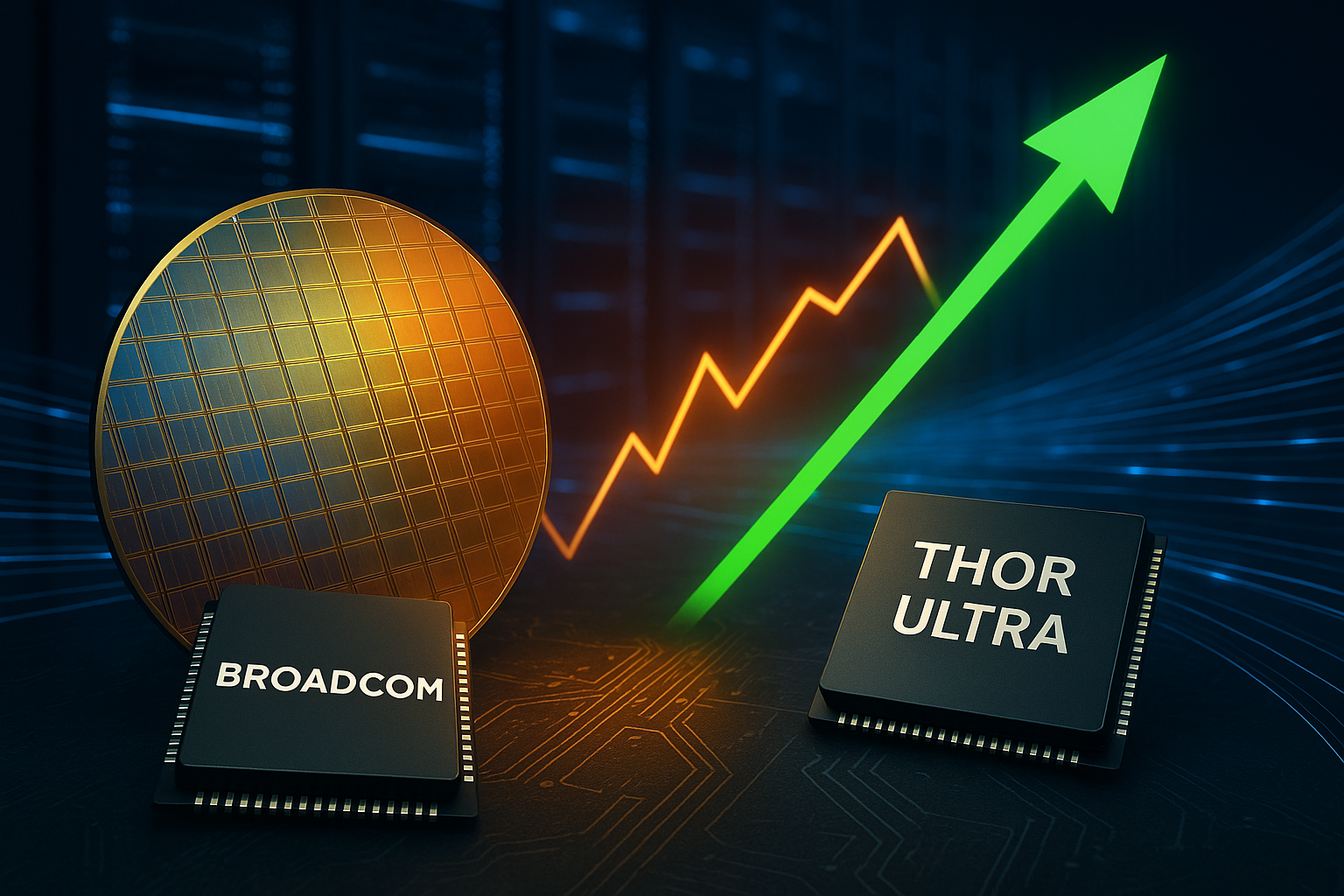
Broadcom has stepped into the spotlight with its announcement of the Thor Ultra networking chip, a bold play aimed at deepening its clash with Nvidia over AI data center dominance. The launch signals that the Broadcom vs Nvidia rivalry is heating up, with connectivity becoming a frontline in the AI infrastructure war.
The New Chip: Thor Ultra
The Thor Ultra is engineered to link together hundreds of thousands of chips inside next‐generation AI compute systems, facilitating massive scale. It is intended as a direct challenge to Nvidia’s networking interface chips, aiming to bolster Broadcom’s footprint in the AI data center stack.
In tandem, Broadcom revealed a multi-gigawatt commitment to OpenAI, planning to provide 10 gigawatts of custom chips starting in 2026, further pushing into territory historically dominated by Nvidia.
Broadcom already has momentum. Its prior networking chip, the Tomahawk 6, doubled performance over its predecessor, setting the stage for its deeper involvement in AI networking infrastructure.
Why This Matters
The significance of Thor Ultra is threefold:
- Strategic chokepoint in AI
The speed and scale of inter-chip communication is a crucial bottleneck in AI systems. By offering a solution, Broadcom positions itself at a critical layer between compute and data. - Ecosystem leverage & open standards
Broadcom doesn’t sell full servers, rather, it provides designs and networking systems to partners. Thor Ultra signals its intention to be more central in the AI infrastructure stack. - Blurring of compute and connectivity boundaries
The launch underscores how networking and chip design are converging. AI workloads demand tighter coupling of compute and transport, which upends conventional layers.
The Competitive Landscape & Risks
Nvidia’s Established Foothold
Nvidia's interconnect technologies (e.g. NVLink, InfiniBand) already enjoy wide adoption. Convincing hyper-scalers to shift architectures is no small feat.
Execution and Integration Complexity
Designing a chip is one thing; ensuring it integrates seamlessly inside vast AI clusters (with latency, power, thermal constraints) is another. Missteps could hamper adoption.
Strategic & Political Risk
Partnerships with large AI firms plus government attention may attract scrutiny over supply chain, trade policy, and national security concerns.
What Lies Ahead
Catalysts to Watch
- Announcements around system integration or deployments using Thor Ultra
- Partnerships or public endorsements from large AI/cloud providers
- Performance benchmarks vs Nvidia’s offerings
Positioning & Strategy
Investors and industry watchers may want to monitor Broadcom’s rollouts, and how customers balance between competing networking stacks. Strategic flexibility may be key.
Sector Impact
If Thor Ultra finds traction, it could shift the dynamics of AI data center builds, prompting more moves toward open networking or diversified stack choices.
Conclusion
With the introduction of Thor Ultra networking chip, Broadcom is raising the stakes in its clash with Nvidia, injecting fresh intensity into the Broadcom vs Nvidia narrative. As AI workloads demand ever more from connectivity, the chip war intensifies with networking as the battlefield. The core theme: in the next era of AI infrastructure, winning compute is no longer enough, winning connectivity might define the victor.