Gold, Silver Smash Record Highs as Fed Rate-Cut Bets Build

By Tredu.com • 12/22/2025
Tredu
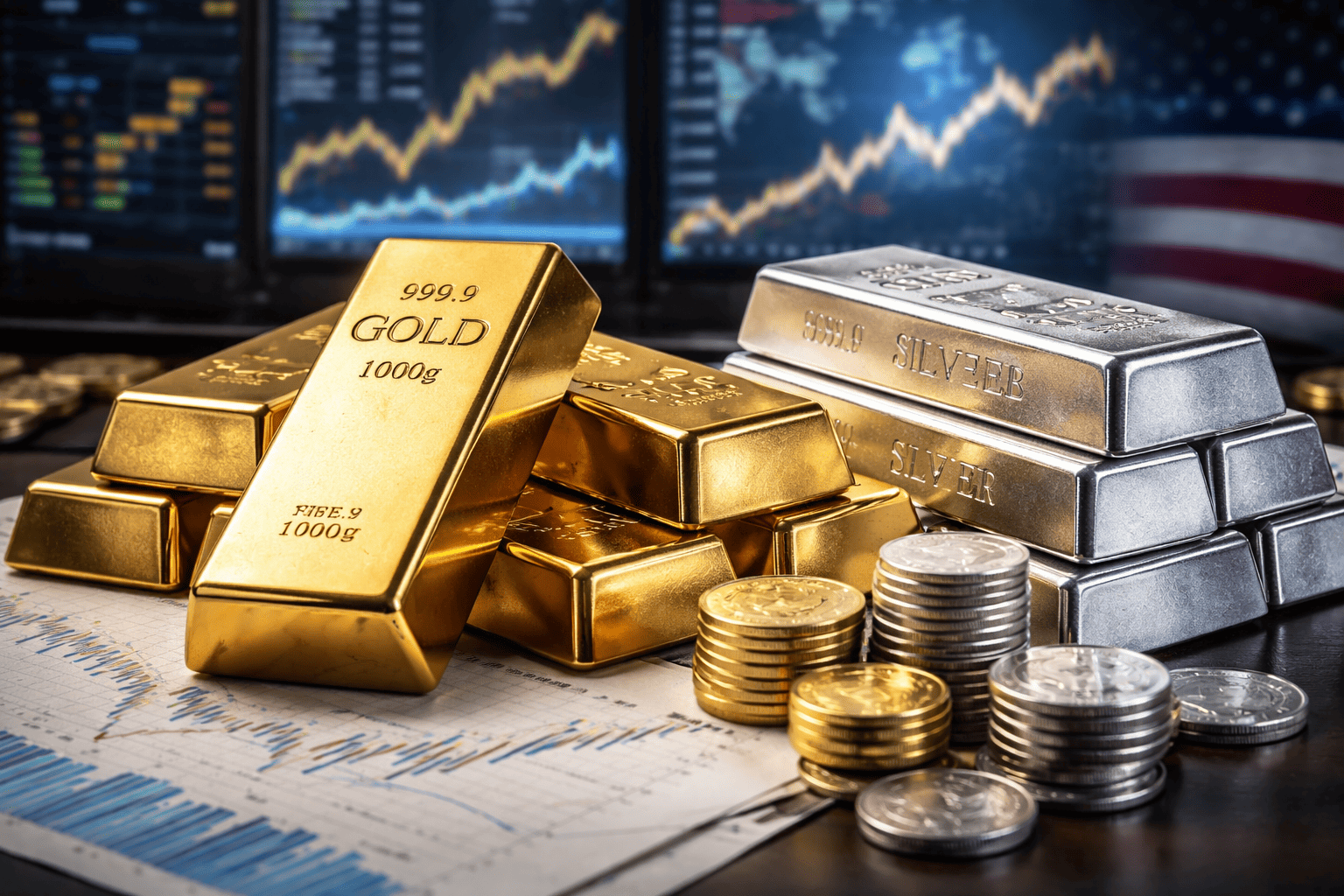
Market move: new peaks for gold and silver
Gold and silver surged to new peaks on Monday, December 22, 2025, as investors rotated into havens and recalibrated the outlook for U.S. interest rates. Spot gold traded above $4,400 an ounce for the first time before easing toward $4,397, while U.S. gold futures held near $4,430. Silver climbed to an all-time high near $69.44 an ounce, extending a year-end rally that has been unusually strong even by precious-metals standards.
The immediate significance is twofold. First, the breakout arrives when market liquidity is typically thinner, which can exaggerate moves and force faster rebalancing by funds that target volatility. Second, it reinforces the idea that the 2025 bullion surge has moved beyond a single narrative and into a broader mix of rate expectations, currency dynamics, and risk hedging.
Fed rate-cut bets build and support non-yielding assets
The main macro driver is that Fed rate-cut bets build into 2026, pulling down expected real yields and lowering the opportunity cost of holding non-yielding metals. When investors anticipate easier policy, gold and silver often benefit because the relative appeal of cash and short-dated bonds diminishes, while hedging demand for real assets tends to rise.
Markets have increasingly leaned toward the possibility of two rate cuts in 2026. That pricing matters because it shapes everything from currency hedges to commodity allocations, especially after a year in which monetary policy signals have repeatedly moved asset prices. In this environment, even small shifts in expectations can push prices through technical levels, prompting additional buying.
A softer dollar boosts global demand
The U.S. dollar’s tone has been another tailwind. A softer dollar tends to lift demand by making dollar-priced metals cheaper for non-U.S. buyers and by encouraging diversification away from currency exposure. For corporates and asset managers with liabilities outside the United States, that currency effect can be just as important as the rate story.
Dollar moves can also influence investor psychology. If traders believe the currency backdrop is turning, they may add to gold and silver as a way to hedge purchasing power, even when inflation is not spiking. That dynamic can keep bids active during dips, especially after a breakout to record highs.
Safe-haven demand adds a risk premium
Geopolitical uncertainty has contributed to the rally by adding a safety premium on top of the macro impulse. Markets have been watching renewed tension around energy and trade, including pressure points tied to Venezuela’s oil flows and broader uncertainty over tariff policy and political scrutiny of central bank independence. When risk sentiment deteriorates, bullion often attracts quick inflows because it is liquid, globally recognized, and easy to deploy as a hedge.
That safe-haven demand can be episodic, but it does not need to be constant to matter. A series of intermittent shocks can keep investors holding a baseline allocation, especially when portfolios are already sensitive to rate volatility and currency swings.
Central bank buying underpins the broader trend
Central bank buying has remained a steady feature of the gold market, supporting the view that some demand is strategic rather than purely tactical. Reserve managers often prioritize liquidity, diversification, and resilience to sanctions or funding stress, which can make gold attractive even at higher prices. This layer of demand can help explain why pullbacks have often been met with renewed interest rather than prolonged liquidation.
Still, official-sector demand does not eliminate volatility. If prices rise too sharply, some buyers may pause, leaving the market more dependent on investment flows and futures positioning. The balance between strategic accumulation and fast-money positioning will be a key determinant of how well new highs hold.
Why silver is moving faster than gold
Silver’s leap has outpaced gold’s, consistent with its smaller market and higher volatility. Silver is both a precious asset and an industrial input, which means it can react to macro hedging as well as supply-and-demand conditions linked to manufacturing and technology. In thin markets, that combination can produce larger percentage moves, especially when momentum strategies chase breakouts.
At a silver all-time high, the risk is that volatility becomes self-reinforcing. Strong gains can attract incremental buying, but they can also trigger sharp reversals if leveraged positions are reduced or if profit-taking accelerates into year-end. Investors tend to watch silver closely for this reason, since its swings can foreshadow broader shifts in precious-metals risk appetite.
The rest of the precious complex is participating
The rally has broadened beyond gold and silver. Platinum advanced to a 17-year high near $2,057 an ounce, and palladium climbed toward $1,786, reflecting strength across the complex. Broad participation can signal that the move is not solely about one metal’s tightness; it can also reflect cross-market allocation to scarce real assets when macro uncertainty rises.
Platinum and palladium, however, are more sensitive to industrial demand than gold. Their follow-through will depend on whether growth expectations remain stable and whether investors continue to treat the rally as a generalized repricing rather than a narrow haven trade.
What could interrupt the rally
Two risks stand out. The first is a shift in the rate outlook. If inflation surprises higher or growth reaccelerates, real yields could rise and challenge the durability of record highs, particularly after such a steep run. The second is year-end positioning. With large gains on the table, funds may choose to lock in profits as books close, especially if liquidity remains thin and intraday moves widen.
Investors will be watching upcoming inflation and labor-market data, the dollar’s direction, and the trajectory of geopolitical stress. For Tredu readers, the key question is whether this surge is primarily a policy repricing or a more persistent flight to safety. If Fed easing expectations remain firm and risk hedges stay in demand, gold and silver may consolidate near these peaks; if either pillar weakens, the market could see sharper pullbacks before attempting the next leg higher.
Other News

The Role of Intelligent Forex Trading Systems in Optimizing Algorithmic Trading Performance
By Tredu.com · 5/20/2026

How Machine Learning Forex Trading Bot Enhances Predictive Accuracy in Forex Markets
By Tredu.com · 5/20/2026

FinancialMarkets.media granted the Official Google Partner certification
By Tredu.com · 5/20/2026