Goodman Jumps on $9.3B Europe Data-Center Partnership With CPPIB

By Tredu.com • 12/23/2025
Tredu
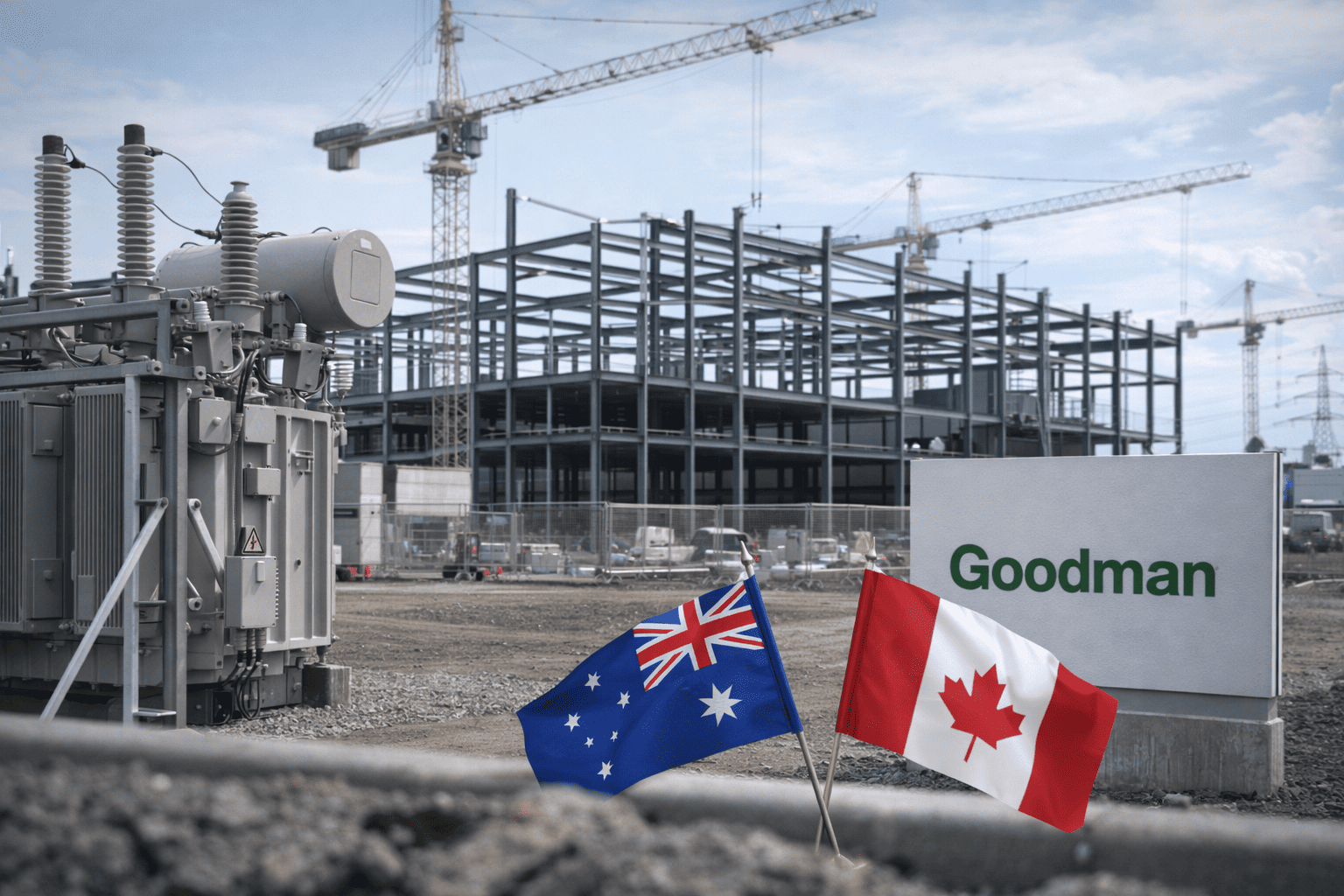
Deal size, structure, and the immediate share move
Goodman jumps on $9.3B Europe data-center partnership with CPPIB, and the market response was swift. The stock rose as much as about 9% intraday to roughly A$31.92, its highest level since early November, before ending the session up about 8% as traders digested the scale of the commitment and the quality of the sites.
The partnership is valued at about A$14 billion (roughly $9.3 billion) and is structured as a 50–50 venture with Canada Pension Plan Investment Board (CPP Investments, commonly known as CPPIB). The initial capital commitment is A$3.9 billion, about 28% of the total partnership value, to fund early-stage development and accelerate projects that are already substantially progressed.
The portfolio comprises four projects across three countries, with two sites in Paris and one each in Frankfurt and Amsterdam. Management is positioning these as prime “FLAP” markets, shorthand for the European hubs most sought after by cloud and AI customers due to connectivity, enterprise demand, and ecosystem depth.
Why the assets are unusually valuable right now
The core scarcity in European data centers is not demand, it is power and permits. Goodman is emphasizing that these locations have secured power connections, planning approvals, and infrastructure work that is already advanced. That matters because interconnection queues and local approvals can push timelines out by years, and hyperscalers increasingly pay for “speed to market” as much as they pay for real estate.
The partnership’s projects have a combined 435 megawatts of primary power capacity and 282 megawatts of IT load, which is the power delivered to servers and computing equipment. Those numbers matter to investors because they translate into a clearer development runway and, potentially, more predictable leasing outcomes once the shells and electrical infrastructure are delivered.
Construction is expected to begin by June 30, 2026, while the overall transaction is expected to complete in phases by March 2026. The sequencing suggests the venture is designed to lock in capital and governance first, then convert the pipeline into construction starts as procurement and contractor schedules are finalized.
What Goodman is trying to become
For years, Goodman’s identity was tied to industrial logistics and warehouse development. This announcement reinforces a strategic pivot toward digital infrastructure, where the limiting factor is not land alone but the ability to deliver powered campuses at scale.
Goodman has been building toward this. The group has described a global data-center pipeline measured in gigawatts across multiple cities, and recent disclosures have shown data centers taking a larger share of development work in progress. The market has been rewarding platforms that can combine land, power, approvals, and capital partners, especially as AI workloads push cloud providers to build faster and larger.
Why investors liked the CPPIB structure
The Goodman CPPIB Europe data-center deal lifts shares partly because it tackles a familiar concern in data-center real estate: balance-sheet strain. Data centers are capital-intensive, and development cycles can be long. A large pension partner reduces the need for Goodman to fund the full build itself, which can help keep gearing lower while still expanding the project book.
The structure also improves financing flexibility. With committed institutional equity alongside Goodman’s development expertise, the venture can potentially secure better terms on project debt, stage capital calls more efficiently, and take a longer view on returns than some shorter-horizon capital sources. In a market where power equipment lead times and grid upgrades can shift schedules, patient capital is an advantage.
What it means for European data-center competition
Europe’s top markets have become crowded with global developers, local specialists, and infrastructure funds competing for the same constrained ingredients: sites near fiber routes and substations, predictable planning pathways, and credible delivery capability. A partnership of this size signals that capital will keep chasing those ingredients, which can push land values and development margins in opposite directions.
For customers, more funded supply is positive, but it may not be enough to eliminate tightness. The key question is whether projects that look “shovel-ready” today can avoid delays tied to transformers, switchgear, and connection works, a persistent bottleneck in many jurisdictions.
Market impact beyond Goodman
The announcement has implications for listed real estate and infrastructure assets more broadly.
First, it supports the thesis that data centers remain a growth engine within property markets, even when traditional logistics or office narratives are softer. That can lift sentiment across segments tied to digital infrastructure, including developers with powered land banks and operators with expansion options in constrained metros.
Second, it reinforces a valuation split inside real estate. Platforms seen as AI infrastructure providers can trade more like growth infrastructure than like conventional REITs, particularly if they can demonstrate a pipeline, capital partners, and recurring development fees. That dynamic can pressure peers without comparable power access or permitting depth.
Third, it points to a higher bar for execution. The market is willing to pay up on announcements, but the rerating tends to hold only if projects move from plans to starts to commissioned capacity on schedule. Any slippage that suggests the “powered advantage” is less firm than advertised can quickly reverse sentiment.
Risks investors will watch
The near-term risks are execution and cost inflation. Data-center builds depend on specialized electrical equipment and tight contractor calendars. Delays can hit returns through higher interest carry and rework costs, even if ultimate leasing demand remains strong.
Regulatory risk is also real. European energy policy is tightening around grid access, sustainability reporting, and local community impacts, which can affect permitting timelines and operating constraints.
Finally, the share move itself creates a technical risk. A sharp one-day jump can attract momentum flows, but it can also invite profit-taking if broader markets weaken or if investors wait for more detail on phasing, returns, and pre-leasing.
Other News

The Role of Intelligent Forex Trading Systems in Optimizing Algorithmic Trading Performance
By Tredu.com · 5/20/2026

How Machine Learning Forex Trading Bot Enhances Predictive Accuracy in Forex Markets
By Tredu.com · 5/20/2026

FinancialMarkets.media granted the Official Google Partner certification
By Tredu.com · 5/20/2026