Meta Commits $1.5B to AI Data Center in Texas to Power Next-Gen Compute

By Tredu.com • 10/15/2025
Tredu
Introduction
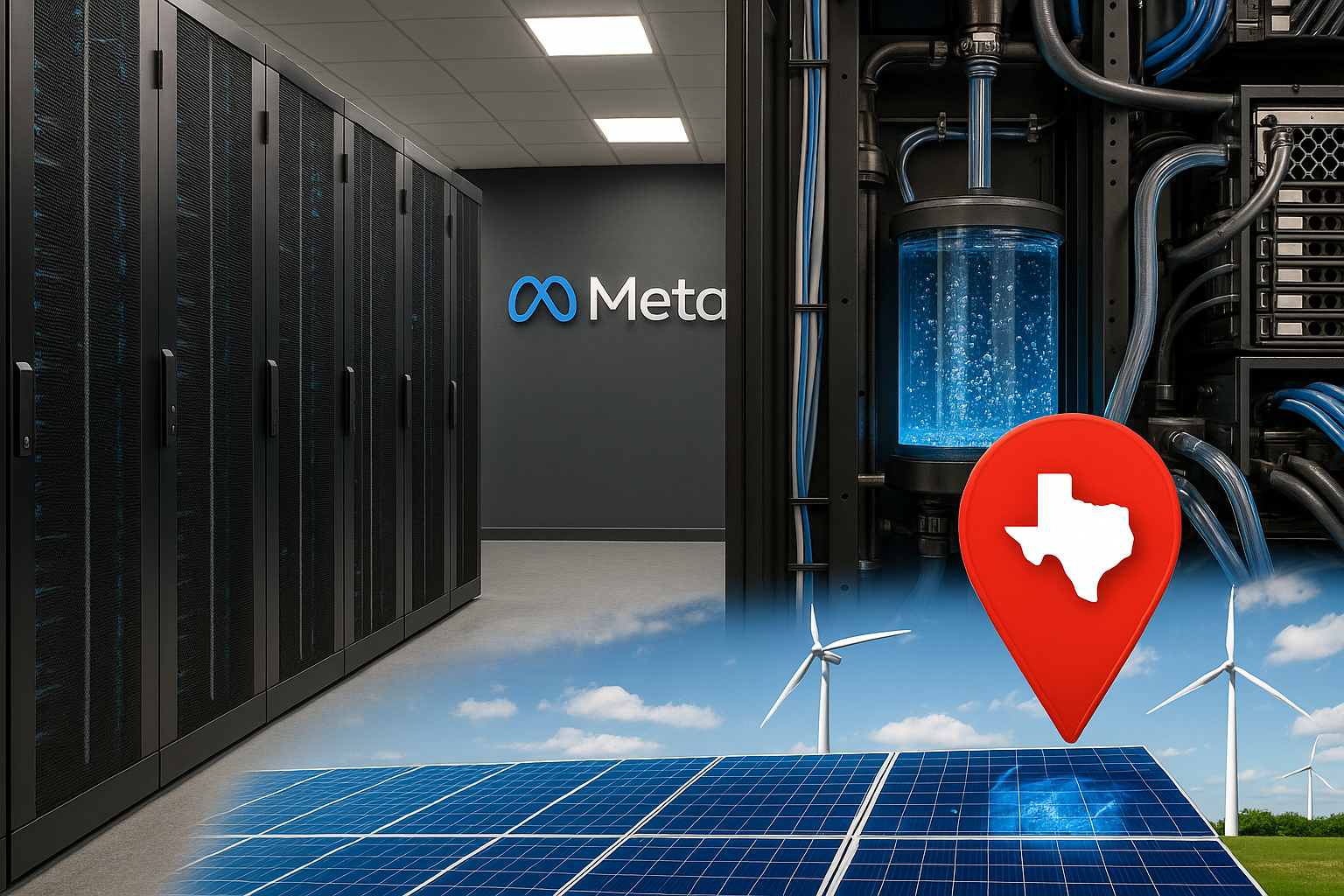
Meta Platforms announced a $1.5 billion commitment toward building a new AI data center in El Paso, Texas, aiming to scale capacity to support next-generation AI workloads. The facility will add to Meta’s global data center portfolio and underscores its deepening bets on AI infrastructure.
Project Details & Strategic Factors
The El Paso facility is Meta’s 29th data center globally and its third in Texas. The project is slated to begin operations in 2028, with scale-out potential reaching 1 gigawatt.
Meta cited El Paso’s strong electrical grid and local skilled workforce as key locational advantages. To align with its sustainability goals, the data center will run on 100% renewable energy and employ a liquid-cooling, closed-loop system that recycles water.
The new site is expected to produce ~100 permanent jobs and require 1,800 construction workers at peak. Meta also pledged to restore twice as much water as the facility consumes, exceeding its 2030 “water-positive” targets.
Why This Move Matters
Building AI Infrastructure at Scale
A 1-gigawatt data center for AI workloads is massive, by design, it enables high density compute, large clusters, and energy-intensive cooling and power demands. With Meta deepening its AI ambitions, robust infrastructure is no longer ancillary, it is foundational.
Strategic Positioning & Ecosystem Entry
As Meta competes with Amazon, Microsoft, Google, and other AI infrastructure builders, owning flexible compute real estate gives it leverage in negotiations, performance, and cost control across its AI stack.
Energy & Sustainability Edge
Meta’s renewable and water-recycling design shows how AI infrastructure must increasingly anchor in sustainable practices, especially to address environmental scrutiny and regulation.
Local & Economic Leverage
Texas is becoming a battleground for tech infrastructure. Meta’s investment adds to a pipeline of data center growth across the state, potentially attracting further partners, incentives, and ecosystem clustering.
Risks & Challenges
- Capital Intensity & Return Horizon
Building such advanced infrastructure is capital-heavy. Return depends on efficient utilization, tenancy, and amortizing power, cooling, and operations costs. - Power & Grid Stability
Even with strong grid credentials, scaling to 1 GW implies vulnerability to local supply disruptions, demand constraints, or regulatory changes. - Technology Obsolescence
AI compute requires constant refreshes in chip, cooling, networking, and system architectures. The facility must remain adaptable. - Regulatory & Community Impact
Water usage, local approval, permitting, and environmental regulation all pose potential friction points.
Outlook & What to Watch
- Phased Deployment & Upgrades
Which parts of the site come online first, and how quickly Meta scales beyond baseline capacity. - Client & Workload Migration
Whether Meta assigns internal AI workloads (e.g. Llama, research clusters) or leases capacity externally. - Benchmark Metrics
Efficiency metrics like PUE, MW density per rack, cooling efficiency, and energy usage per AI inference. - Competitive Moves & Land Grab
Meta’s announcement may trigger faster moves from other hyperscalers or data center providers in Texas and adjacent regions.
Conclusion
Meta’s $1.5 billion commitment to a new AI data center in Texas is more than expansion, it’s a statement of intent. As data center infrastructure becomes central to AI competitiveness, Meta is placing its bets where compute meets power, design meets sustainability, and scale meets speed.
The core theme: in the race for AI infrastructure dominance, scale and strategic location may decide who leads.
Other News

The Role of Intelligent Forex Trading Systems in Optimizing Algorithmic Trading Performance
By Tredu.com · 5/20/2026

How Machine Learning Forex Trading Bot Enhances Predictive Accuracy in Forex Markets
By Tredu.com · 5/20/2026

FinancialMarkets.media granted the Official Google Partner certification
By Tredu.com · 5/20/2026