Nvidia Faces Google AI Chip Challenge as Competition Widens

By Tredu.com • 12/5/2025
Tredu
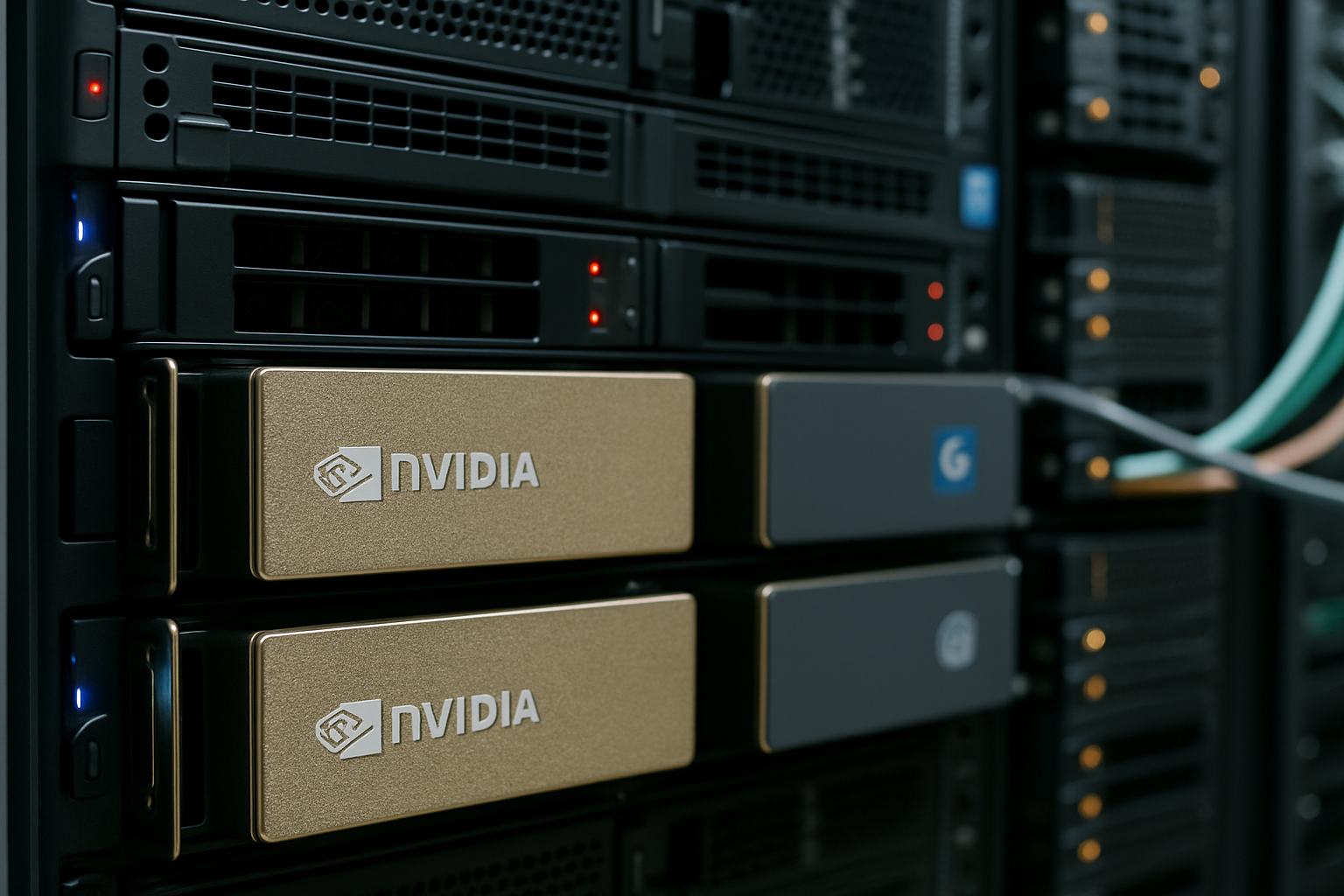
Nvidia faces Google AI chip challenge as competition widens and the latest market reaction shows how closely investors are watching competitive moves in the AI hardware industry. Nvidia remains the global leader in AI processors, but reports that Google could sell its AI chips to Meta signaled that one of its largest customers may be evolving into a more direct competitor. A November 24 report suggested the Google deal with Meta could be worth billions of dollars, sending Nvidia's stock lower by 2.5 percent the following day. Currently the NVIDIA Corporation Common Stock (NVDA) stock price is 183.64 dollars, reflecting a plus 0.10 percent move since the market opened.
The company has publicly stated that its chips remain a full generation ahead of Google’s tensor processing units (TPUs). This competitive pressure is not limited to Google. Amazon also contributed to the shifting landscape by announcing the public availability of its Tranium3 chip, which the company claims can cut AI training costs by up to 50 percent compared to other hardware. These developments strongly highlight how hyperscalers are expanding internal chip programs as demand for AI infrastructure grows. Even with these assertive moves, Nvidia maintains strong momentum, backed by widespread industry adoption and a deep product ecosystem, helping it retain its market edge despite the expanding competition.
GPUs and the Custom Silicon Ecosystem
Google’s TPUs and Amazon’s Tranium3 chips belong to a category of processors known as ASICs, or application-specific integrated circuits. These processors deliver exceptionally high performance for targeted workloads precisely because they are custom-engineered for narrow use cases. Analysts say this design gives hyperscalers efficiency advantages for select tasks, although it does not necessarily render Nvidia’s GPUs inferior.
Nvidia’s GPUs, which are the backbone of modern AI, are designed specifically to be flexible and are currently deployed across multiple cloud platforms, including those operated by Google, Amazon and Microsoft. Their underlying architecture supports varied workloads such as training large AI models, robotics, video gaming and autonomous vehicle computing. Nvidia also sells complementary networking products like NVLink, which Amazon plans to deploy alongside its Tranium4 and Graviton CPUs in its future servers. This broad product ecosystem, combined with the powerful CUDA software stack, reinforces Nvidia’s market lead even as hyperscalers invest heavily in custom silicon.
Why Hyperscalers Still Need Nvidia
Hyperscalers possess the immense financial scale required to design and produce custom chips, allowing them to amortize costs over long periods. Most other companies lack this capability and rely instead on general-purpose processors from Nvidia or AMD for advanced computing needs. Crucially, even hyperscalers that build ASICs continue to purchase Nvidia chips in significant volumes because their internal chips simply do not cover all necessary workloads.
During Nvidia’s second quarter earnings call, management noted that cloud providers made up roughly half of the company’s total data center revenue. That a substantial share remains notable even as companies like Google and Amazon advance their in-house chips. ASICs face a key limitation: when specific workloads change or AI models rapidly evolve, new chips may need to be designed, manufactured and deployed. Analysts say this inherent time and cost inefficiency is a major reason hyperscalers continue to place large orders for Nvidia GPUs despite increasing investment in their own custom processors. The pressure remains high, but Nvidia faces Google AI Chip challenge with substantial existing commitment.
Economics and Future Demand Projections
The decision to build ASICs allows hyperscalers to optimize performance per watt and performance per dollar, which are crucial metrics in large-scale AI training environments. For workloads where internal chips can outperform GPUs on cost or efficiency, the significant investment is fully justified. Yet for broader tasks or rapidly evolving AI models, general purpose GPUs remain the essential, flexible tools.
Companies like Meta could significantly benefit from Google’s TPUs by gaining additional computing capacity during a period when market demand for Nvidia chips substantially exceeds existing supply. Nvidia continues to signal strong future demand, with executives pointing to approximately 500 billion dollars in expected revenue from Blackwell and Rubin chips through calendar 2026. CEO Jensen Huang recently told investors that Blackwell sales are exceptionally strong and that cloud GPUs are currently sold out, underscoring the severity of the supply-demand imbalance.
Competition Expands but Nvidia’s Lead Holds
The rising prominence of internal chip initiatives at Google and Amazon does not undermine the central thesis that Nvidia faces Google AI Chip challenge as competition widens without losing its market edge. Analysts broadly expect the AI chip market to expand significantly, allowing substantial room for Nvidia alongside hyperscalers with custom silicon and various additional competitors. One analyst noted that while a Google TPU deal may boost Broadcom, which manufactures Google’s chips, Nvidia remains the leading force in AI hardware.
The chip industry is moving at an unprecedented pace, with new architectures and rapidly shifting workloads reshaping the competitive landscape. For now, Nvidia’s scale, inherent flexibility and deep industry penetration keep it firmly at the forefront of the AI chip race, even as the field becomes more crowded and competition widens. The strategic partnership between Google and Meta is a major development in the AI chip challenge.
Bottom Line
Nvidia faces Google AI chip challenge as competition widens, yet its strong market position remains intact. Growing competition from hyperscalers is unlikely to diminish Nvidia’s leadership position as long as demand for versatile, high-performance GPUs continues to surge across the expanding AI ecosystem.