Nvidia to Buy Groq for $20B in Biggest AI Chip Deal Yet

By Tredu.com • 12/24/2025
Tredu
Market move and what is driving it
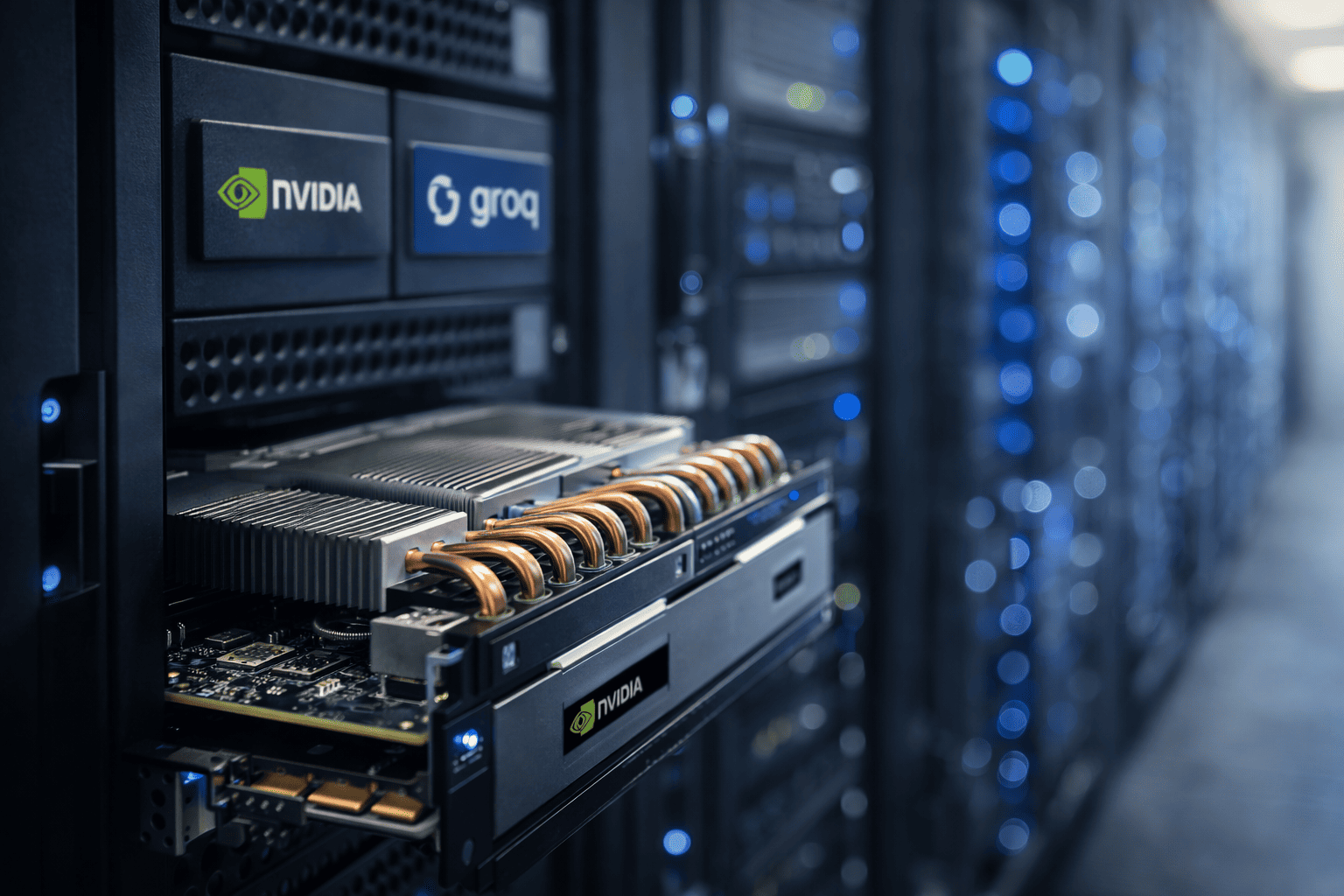
Nvidia has agreed to buy Groq for $20B in cash, a transaction disclosed on December 24, 2025 that would be its biggest acquisition and one of the largest deals in AI hardware. The announcement matters because it points to a new phase of the AI buildout, where the bottleneck is less about training giant models and more about serving them cheaply and reliably to users.
The market reaction was muted in holiday-thinned trading. The Nvidia Groq acquisition is being read as a multi-cycle bet, so investors shifted to two questions: how fast Nvidia can integrate the assets into product roadmaps, and whether regulators slow or reshape the deal.
Deal terms, scope, and what Nvidia is really buying
The reported purchase price is about $20 billion, all cash, a scale that signals Nvidia is paying for speed and strategic position rather than current revenue. The acquisition is expected to include Groq’s chip and software assets, while leaving out Groq Cloud, which would remain outside the transaction. That Groq Cloud carve-out suggests Nvidia’s priority is silicon and the toolchain, not building another cloud channel that competes with its largest customers.
Groq’s pitch is purpose-built acceleration for model serving. Rather than leaning on general-purpose GPUs for every workload, it has focused on inference, the stage where models respond to prompts, classify data, or generate outputs in real time. Inference is usually measured in cost per response, latency, and power efficiency; small gains can compound quickly when usage scales.
Why inference is becoming the profit pool
Training is capital intensive and lumpy, tied to model cycles and bursts of capacity ordering. Inference tends to be steadier and more volume driven, because deployed models keep running every minute a product is live. As AI features move from pilots to defaults inside search, customer support, coding, and enterprise workflow tools, inference capacity becomes a recurring expense that buyers want to squeeze.
That shift is why the Nvidia-Groq buyout targets AI inference chips, not just another training accelerator. If inference economics become the dominant driver of total AI spend, customers will compare architectures more aggressively, and the winner will be the platform that offers the lowest total cost while meeting reliability and latency targets.
Competitive dynamics and customer behavior
The deal lands in a market that is moving toward specialization. Cloud providers are developing custom chips to control cost and supply, while traditional rivals push alternative accelerators and full-stack systems. Nvidia’s advantage has been its ecosystem, including software, developer tooling, and deep relationships with data-center operators. A dedicated inference architecture could widen that moat if it integrates cleanly with existing workflows.
For customers, the decision is rarely “GPU or not.” It is usually a portfolio choice across workloads. Some operators will keep training on GPUs and route inference to the cheapest and most predictable option; others will prioritize simplicity and standardize on one vendor if the economics are close enough. Nvidia will be trying to win both customers: those who want a single integrated stack, and those who want a menu of silicon optimized for each phase.
Market impact: what could move stocks and spreads
A large all-cash acquisition can shift investor math. It raises questions about capital allocation, especially if markets begin to worry about an AI spending downshift in 2026 or a normalization in margins as competition intensifies. At the same time, it can support the broader semiconductor complex by signaling that strategic scarcity still commands premium prices, and that buyers will consolidate around differentiated architectures.
The second-order effects could be meaningful. A successful integration would likely pressure smaller inference-focused startups by reducing their room to differentiate against an integrated incumbent. It could also raise expectations for more semiconductor M&A among adjacent suppliers, including networking, memory, optical components, and power and cooling infrastructure, because inference at scale is constrained by systems, not only chips.
Risks, scenarios, and what to watch next
Regulatory review is the first gate, and an antitrust review could test whether the deal is seen as tightening control of critical AI infrastructure. Even if approval is likely, a long review can freeze customer decisions and create uncertainty for engineers and partners.
Execution risk is the second gate. Nvidia would need to clarify how Groq’s architecture and toolchain sit alongside its own products without confusing buyers or fragmenting developer support. The upside scenario is a cleaner note: one platform, multiple accelerators, unified software, and easier workload placement. The downside scenario is overlap, slower product cadence, and customers choosing to diversify earlier than Nvidia would like.
The immediate watch list is concrete: confirmation of the carve-out structure, any disclosed timeline for approvals, retention plans for Groq’s technical leadership, and early signals from major data-center buyers on whether they view this as a genuine inference cost breakthrough or mainly a defensive move.
In plain terms, Nvidia agreed to buy Groq for $20B, the biggest AI chip deal ever, to reinforce control of the inference layer where AI usage is compounding fastest. Whether the deal pays off will depend less on the headline price and more on how quickly Nvidia can turn the acquisition into measurable deployment wins without triggering a regulatory or execution hangover.