Ukrainian Drones Hit Russian Oil, Gas Sites, Lifting Crude Risk

By Tredu.com • 12/25/2025
Tredu
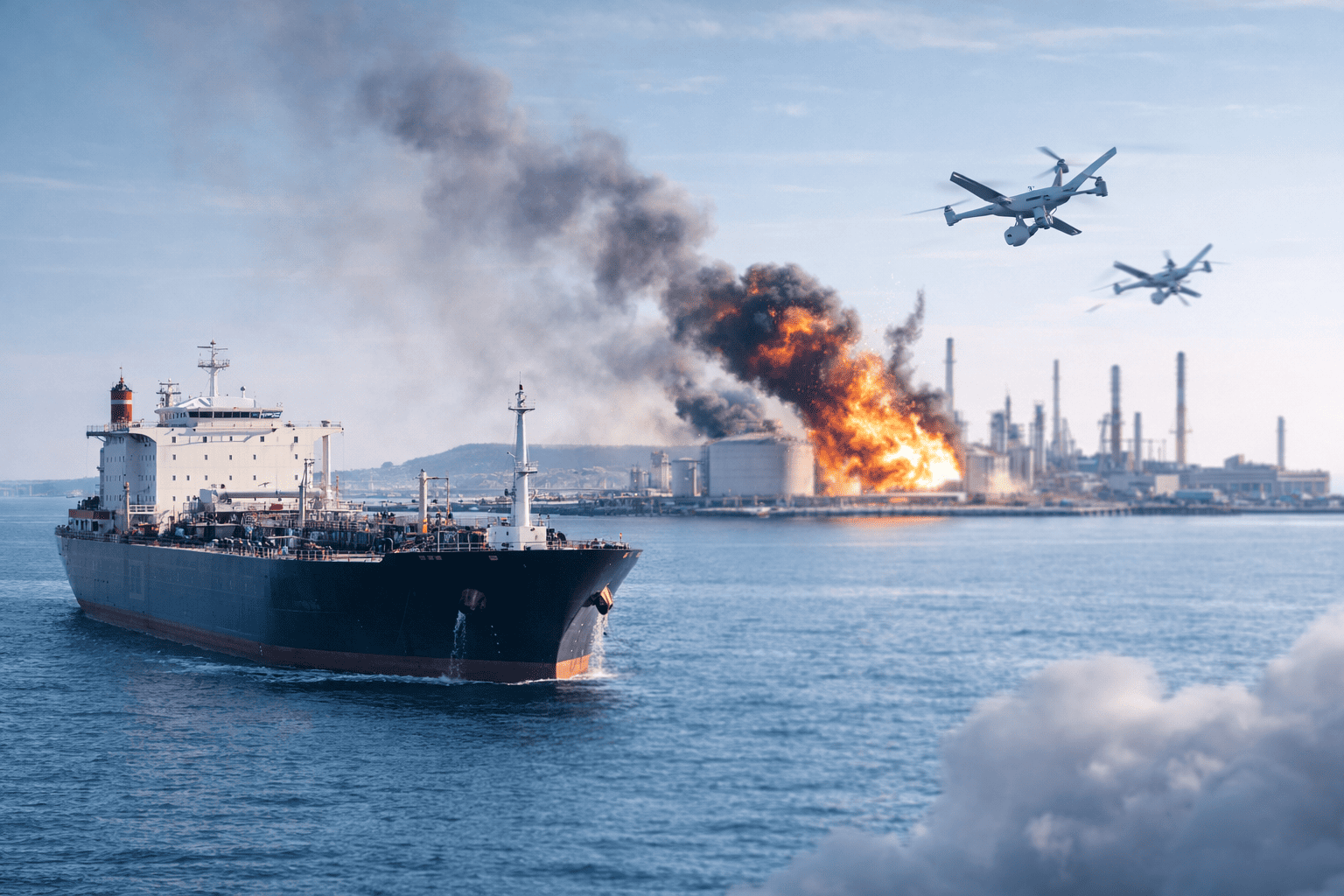
Ukrainian drones strike oil tanks and a gas plant as energy risk returns to the tape
Ukrainian drones hit Russian oil, gas sites on Thursday, December 25, 2025, striking oil product tanks at the port of Temryuk and hitting a gas processing plant in the Orenburg region. The attacks underline a strategy of targeting energy infrastructure that supports state revenue and military logistics, and they arrive at a time when year-end liquidity can amplify short-term price swings.
For markets, Russian oil and gas strikes lift crude risk premium when they create uncertainty around exports, storage availability, and operational continuity, even if the immediate physical impact is limited. Traders typically respond first by adding a geopolitical buffer into prompt pricing, then by watching flow data to see whether disruptions persist long enough to alter balances.
What was hit and why these locations matter
Temryuk is a port node in southern Russia that handles oil product storage and coastal shipping flows in the broader Black Sea and Sea of Azov region. Strikes on oil product tanks matter because refined products can be harder to reroute than crude, and storage damage can constrain local logistics even when production elsewhere remains steady. If tank integrity is compromised or fire control takes time, the near-term effect can be bottlenecks, slower loadings, and higher demurrage costs.
The Orenburg gas processing plant is located deep inland, and an attack there highlights reach rather than proximity. Processing plants are critical links between upstream production and downstream consumption. They remove impurities and separate natural gas liquids, enabling gas to flow through pipelines and allowing valuable byproducts to be monetized. Even a partial outage can force operators to divert flows, flare gas, or reduce intake at upstream fields until processing capacity normalizes.
Why energy infrastructure is a high-leverage target
Energy is the primary hard-currency engine for Russia’s state finances, and it is also the backbone of domestic fuel supply for transport, industry, and military logistics. Strikes that complicate exports or force costlier workarounds can erode net revenue even when headline production is unchanged. Markets pay attention because the effect is nonlinear. A small amount of damage can have an outsized impact if it hits the right choke point, such as storage, loading equipment, or processing systems that lack quick redundancy.
This is also why the market distinguishes between one-off hits and repeatable disruption. The first incident lifts uncertainty. The second and third incident can change behavior, prompting traders, shipowners, and insurers to price higher risk into freight and to demand wider discounts for barrels exposed to heightened interdiction or operational risk.
Crude market implications: risk premium, differentials, and time spreads
The most immediate crude market response is usually a higher risk premium in prompt pricing, particularly for Atlantic Basin barrels, where shipping routes and refinery configurations are sensitive to disruptions in Black Sea-adjacent logistics. When traders fear that export friction could rise, they often bid up near-dated contracts relative to later months, steepening backwardation or reducing contango, depending on the starting structure.
Differentials can also react. If refined product logistics tighten, refiners may adjust run rates and crude slates, influencing demand for specific grades. Heavy sour demand, middle distillate cracks, and regional product spreads can move even when global benchmark moves are modest. In short, the impact can show up as relative pricing shifts rather than a uniform jump in Brent or WTI.
Refined products: the bigger sensitivity in a port-tank strike
Oil product tanks are directly tied to gasoline, diesel, and fuel oil distribution. If storage at Temryuk is constrained, flows can back up, forcing alternative storage, rerouting to other ports, or slower shipping schedules. That tends to raise local freight and can lift regional product prices if buyers anticipate delays.
For product markets, the key is duration. A brief fire that is contained quickly may have limited effect beyond a headline-driven bump. A longer disruption can tighten prompt supplies, especially in thin holiday markets where incremental coverage buying can push prices more than normal.
Natural gas and liquids: why Orenburg matters even without a pipeline shock
Europe’s direct dependence on Russian pipeline gas has declined sharply, but gas and gas liquids still matter for broader energy pricing, especially through LNG competition, industrial feedstocks, and winter heating demand. If a processing plant disruption affects natural gas liquids output, it can ripple into petrochemical feedstocks and domestic fuel blending components.
The larger signal is that infrastructure risk is widening beyond border regions. Markets tend to treat deep strikes as a reminder that operational risk is not confined to frontline geography, which can influence how investors price Russian energy assets, how counterparties structure contracts, and how much buffer buyers keep in inventories.
Broader market implications: volatility, FX, and risk appetite
Geopolitical energy shocks tend to transmit into equities and currencies through inflation expectations and volatility. If crude prices rise meaningfully, it can pressure rate-sensitive sectors by nudging inflation breakevens higher and complicating expectations for monetary easing. Energy equities may benefit, while transport and consumer-sensitive names can lag.
In currencies, a sustained oil move can support petrocurrencies and weigh on importers, but the direction depends on the broader risk mood. If the headline is framed as escalation risk, safe-haven positioning can dominate, lifting the dollar and pressuring higher-beta currencies.
What to watch next
Three indicators matter over the next several sessions. First, whether there is evidence of sustained export or product-flow disruption, such as slower loadings, extended port delays, or persistent storage constraints. Second, whether additional strikes follow, since clustering is what turns a risk premium into a re-rating. Third, the market’s freight and insurance response, because those costs often reveal how much counterparties believe the risk has structurally changed.
Ukrainian drones hit Russian oil, gas sites, lifting crude risk at the margin, but the lasting market impact will depend on whether these events translate into measurable flow disruptions rather than isolated incidents.
Other News

The Role of Intelligent Forex Trading Systems in Optimizing Algorithmic Trading Performance
By Tredu.com · 5/20/2026

How Machine Learning Forex Trading Bot Enhances Predictive Accuracy in Forex Markets
By Tredu.com · 5/20/2026

FinancialMarkets.media granted the Official Google Partner certification
By Tredu.com · 5/20/2026